Communications System for
otto
Several communications challenges arise from our ability to use multiple
robots and beacons. We need to determine our robots' positions relative to the
beacons, and we need to be able to exchange a limited amount of control
information among the robots. In order to accomplish this, we will be using a
single-master TDMA ultrasonic and RF network.
RF Subsystem
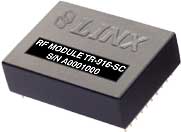 At the heart of the network are bidirectional
RF modules from Linx
Technologies. These are integrated half-duplex FM radio modules; we will use
a single master located on the mama bot to implement a time-sharing protocol.
Ten times a second the master will transmit a code instructing a particular
remote device that it is its turn to talk; it will then switch in to receive
mode and all stations will listen for the response. In this straightforward
manner the half-duplex devices can be easily used to provide a low data-rate
bidirectional channel between the robots.
At the heart of the network are bidirectional
RF modules from Linx
Technologies. These are integrated half-duplex FM radio modules; we will use
a single master located on the mama bot to implement a time-sharing protocol.
Ten times a second the master will transmit a code instructing a particular
remote device that it is its turn to talk; it will then switch in to receive
mode and all stations will listen for the response. In this straightforward
manner the half-duplex devices can be easily used to provide a low data-rate
bidirectional channel between the robots.
Had the competition been even six months later, it would have been possible
to use the now-emerging CDMA RF systems, based around standards such as Bluetooth. Unfortunately, the current
product offerings are too new to be reliable, and most are not yet even
available, so we will insted implement the above-described TDMA solution.
Telemetry
Three of the five balloons
are stationary; we can therefore use their beacons to provide us with absolute
positioning on the table. In order to do this, we need to use some sort of
telemetry system. Although a custom RF telemetry solution is conceivable, it
would be unlikely to be successful on our timeframe. However, by taking
advantage of the slow speed of sound relative to the speed of light, it is
comparatively easy to construct an acoustic telemetry system on top of a
real-time RF data network. It simplifies the mathematics and permits the custom
analog hardware to operate at a much lower frequency (40kHz versus hundreds of
Mhz).
The concept is relatively simple. Using the RF system, we instruct each
beacon in turn to emit a brief ultrasonic pulse. Since the propogation time of
the RF signal is instantaneous relative to the speed of sound, that pulse is
emitted immediately as far as the ultrasonic telemetry is concerned. Receivers
on the robots then measure the time delay to the arrival of the leading edge of
the pulse. Unless the path from the beacon to the robot is totally occluded, the
leading edge arrival time will necessarily correspond to the distance between
that beacon and that receiver. By comparing our distances to the multiple
stationary beacons we can determine our positions, and by comparing the
distances of multiple receivers to the mobile beacons we can determine their
positions relative to our own. This is equivalent to but crucially different
from a phased array system: we are conducting an exclusively time-domain
measurement and we have an absolute reference time for each pulse. This
simplifies implementation dramatically.
Custom Hardware
The network and the
robots themselves require custom hardware. Most notably the ultrasonic and TDMA
systems are in-house designs extending prior work with a similar system at the
MIT Media Lab. These boards are currently being finalized, and schematics and
PCB layout for most of the network and robot controll boards will be available
here by around the 12th of March. Check back in the week following that date for
pictures of the complete devices.